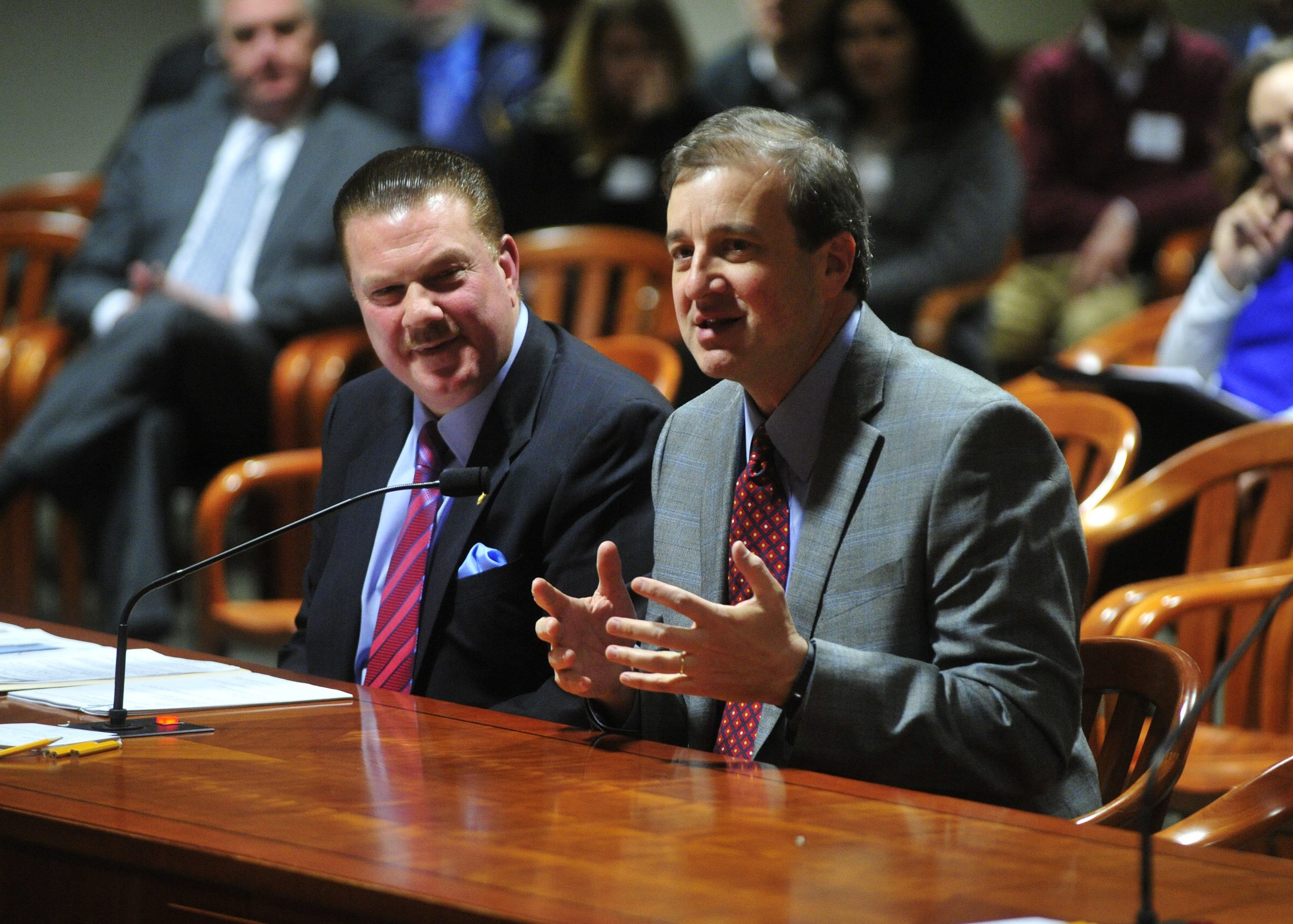
Scott Yates testifying before the Michigan Legislature with the bill sponsor in 2018.
As is always the case, the implementation details could dramatically impact you and your organization. Do you want to sit back and let it happen to you? Or do you want to be part of the alliance making sure your interests are being represented?
The Lock the Clock Alliance is the only organization working behind the scenes to make sure they get the details right.
Schedule a BriefingThe Sunshine Protection Act has passed two committees in this session. That has not happened before. But the House version and the Senate version are not the same bill.
The Senate Commerce Committee passed S. 29 with a two-year phase-in amendment in April 2025. That amendment was the direct result of work behind the scenes by Scott Yates, founder of the Lock the Clock movement. The House Energy and Commerce Committee passed its version—without a phase-in—48–1 in May. That bill is now in the must-pass transportation bill.
Before a bill becomes law, both chambers have to agree on the same text, and both need to agree to pass it. The two-year phase-in is currently in one version and not the other. The industries that need transition time—airlines, logistics, retail, tech, outdoor recreation—have a direct stake in which version prevails.
The phase-in is also needed to help get the Sunshine Act passed. Small but vocal minorities are advocating against the bill, and the two-year phase-in blunts nearly all of the opposition.
Being a part of this alliance is being a part of the team that will finally see an end to the clock changing. This is your opportunity to be a part of that winning team.
Scheduling systems, software applications, labor agreements, and consumer-facing operations have all been built around the current time regime. Airlines have international coordination requirements. Software companies carry DST handling logic across every product. Retailers plan seasonal campaigns around evening daylight patterns.
And for states, it may be that permanent Standard Time makes sense. This is ultimately a states’ rights issue. The solution for Massachusetts may be different than the solution for Indiana. But without the phase-in, there’s no opportunity for states to opt out of mandatory permanent Daylight Saving Time.
With the phase-in, states can consult with school districts, local governments, and their citizens, and decide. As a practical matter, this only applies to a handful of states—especially those on the west side of their time zones. This will not create a patchwork. We have a patchwork now, and this will reduce complexity, not increase it.
A two-year phase-in gives every one of those systems time to adapt without emergency patches or chaotic interim workarounds. It also addresses the pediatric sleep and school-start concerns that have historically created opposition to permanent time proposals.
The only widely acceptable implementation plan for permanent daylight saving time in the United States.
The phase-in was adopted by Senator Ted Cruz — S. 29 passed Senate Commerce 16–12
The Lock the Clock Alliance works with trade associations and companies in travel, retail, technology, aviation, and outdoor recreation to protect the two-year implementation framework as the Sunshine Protection Act moves through Congress.
This is not a broad policy campaign. The core ask—a two-year phase-in—is already in the Senate version. The work is to keep it there, and to make the case to the House that it improves the bill rather than complicating it.
Founding members shape the strategy… (And they also get credit for it.)
He started the DST conversation in 2015 and has been building the case, the relationships, and the policy framework since then. He has had a large or small part in passing legislation in more than 20 states, and has become the go-to expert for legislators and the media.
The two-year phase-in that is now in the Senate bill was the brainchild of the Lock the Clock movement. The Senate named its hearing after his movement. When the bill needed a credible implementation plan, it was Scott’s idea that passed.
The Alliance has retained Paul Johnson of Slipstream Advocacy as its Washington representation. Johnson brings senior House staff experience and established relationships with the congressional offices and trade associations central to this legislation. He led the efforts in the House to build support for the Daylight Act, which would empower states to lock the clock.
Scott Yates testifying before the Michigan Legislature with the bill sponsor in 2018.
Scott played a role in nearly every one of these bills—sometimes testifying directly, sometimes providing the policy framework that state advocates adapted, and always giving the issue the national media presence that helped local legislators make the case.
A briefing covers the current status of both the House and Senate versions, what the risks are for your sector, and what the Alliance is doing to protect the phase-in framework. There is no pitch. If there is a fit, we will find it.
Request a Briefing